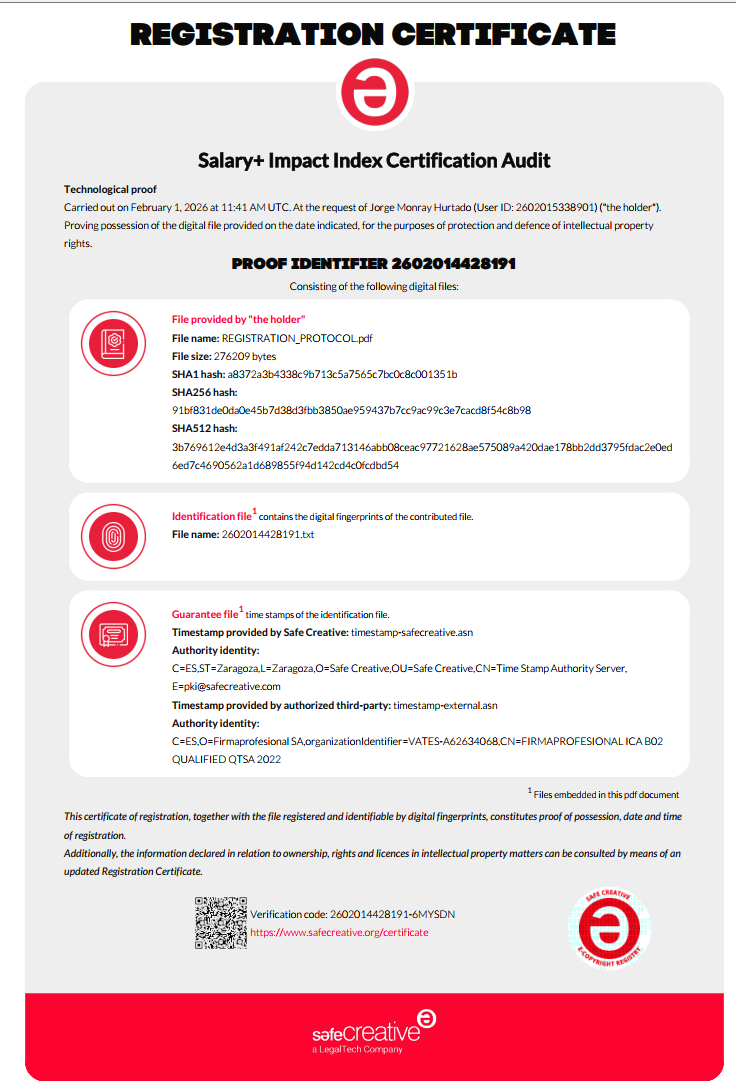
SALARY+ IMPACT INDEX© CERTIFIED
This certification is based on an independent, outcome-based audit that quantifies employee economic gain using the Salary+ Impact Index (SII), comparing total compensation value against a traditional benchmark.
SALARY+ IMPACT CERTIFICATION
Outcome-Based audit that measures the economic impact of flexible work on employee compensation
SALARY+ IMPACT CERTIFIED REGULAR CATEGORY
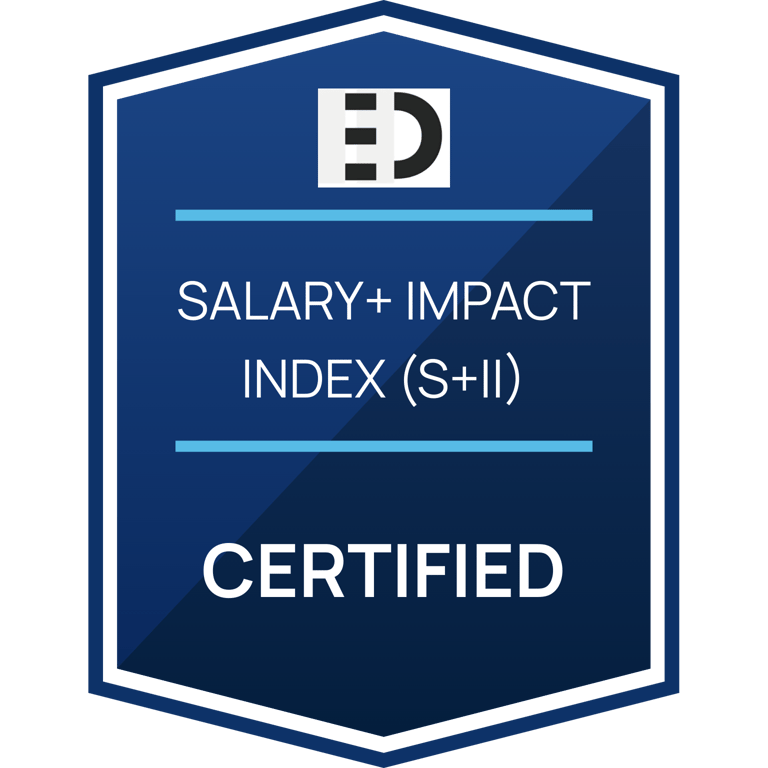
The technical base of this certification is that through the Flexible work arrangements, the employee receives an equivalent of a 10%-30% extra salary. Salary+ Impact Index ≤ 1.3
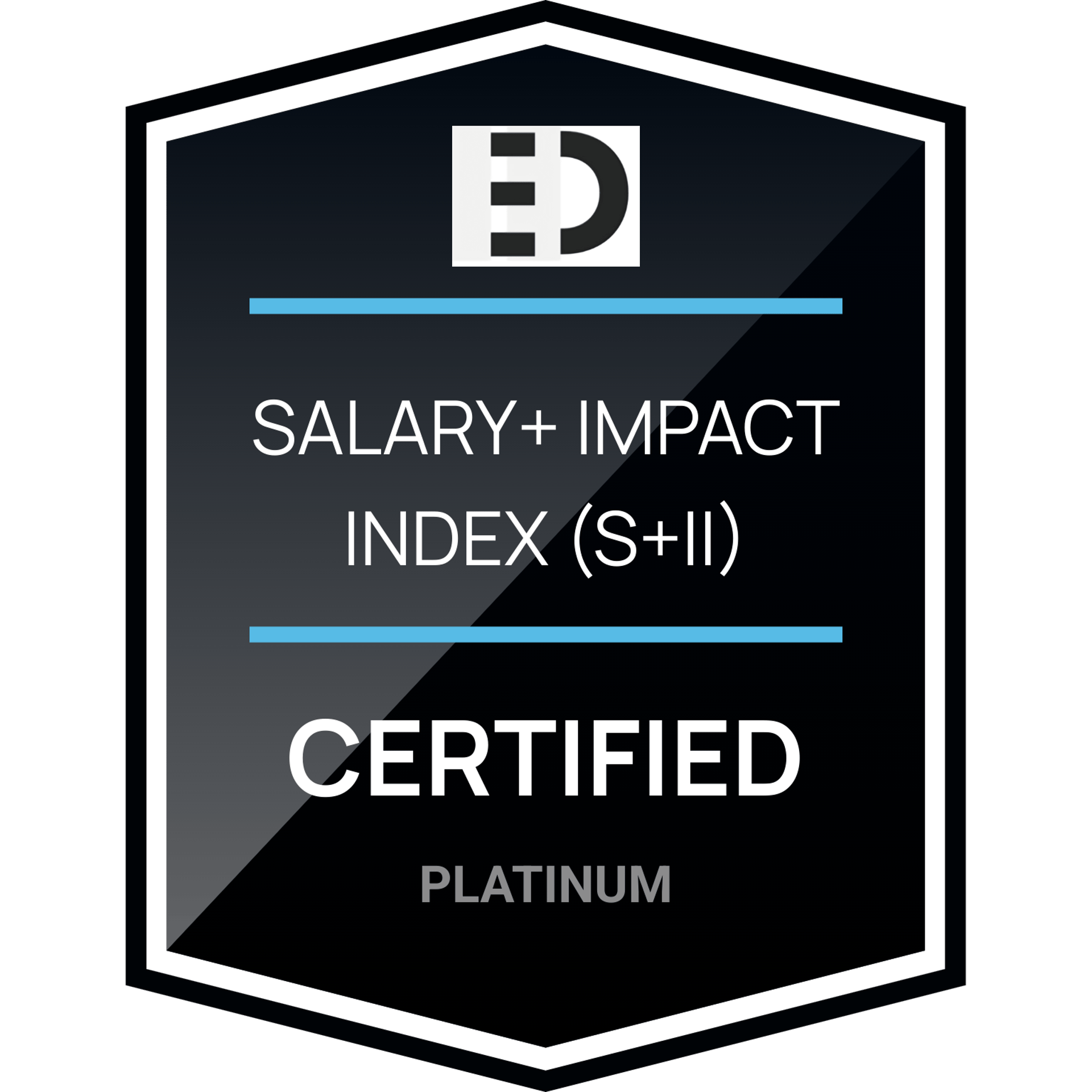
SALARY+ IMPACT CERTIFIED PLATINIUM CATEGORY
The technical base of this certification is that through the Flexible work arrangements, the employee receives an equivalent of a 30% extra salary. Salary+ Impact Index ≥ 1.3
METHODOLOGY
Salary+ Impact Index™ Certification registered certification-audit is awarded through an outcome-based audit that measures the economic impact of flexible work on employee compensation. The assessment evaluates whether flexibility-driven operating models translate into higher total economic value for employees compared to a traditional, office-based benchmark. Using the Salary+ Impact Index (SII), the methodology compares Total Employee Economic Compensation — including salary, cash benefits, economic value of personal time, and verified cost savings directly attributable to flexible work — against baseline compensation for comparable roles. Results are calculated using aggregated, anonymized data and validated annually to ensure consistency, materiality, and sustainability.
Scope of the Certification
1. Scope of the Certification / Audit. What the Salary Impact Index (S+II) Audit DOES
The Salary+ Impact Index audit measures outcomes, not intentions. It quantifies whether flexible work produces a positive, measurable economic impact on employees, compared to a traditional work benchmark.
Specifically, the audit:
· Measures total employee economic value, not just base salary (salary + discounted costs + verified and calculated flexibility-related monetary rewards based on the economic value of personal time)
· Assesses impact and outcomes, not policy design. It evaluates what employees actually gain extra in their salaries, not how flexibility is written in HR manuals. The payment is equivalent to the monetary rewards received through the value of the flexible work arrangements, and the extra payment is based on net savings derived from flexibility and the price of the personal time per hour, because allocating flexible work allows employees to use their free time more often. Attributes economic effects to flexible work mechanisms, such as:
Reduced commuting costs
Time savings converted into paid work or compensation
Location-independent pay structures
Flexibility-enabled productivity sharing
Reward for some time of flexible work under the umbrella of the Economic Value of the Personal Time (EVPT) equation
The Salary+ Impact Index Certification Audit uses a benchmark comparison. Results are compared against equivalent salaries (index) under traditional, office-based conditions.
Works with aggregated, anonymized data. No individual employee evaluation or performance scoring. Produces a numeric, comparable score (S+II). Allowing cross-company, cross-sector comparison.
In short, the S+II audit answers one question: Does flexible work materially increase what employees earn or keep? The results are always compared to the baseline traditional salary without flexible work arrangements in place.
What the Salary+ Impact Index Audit (S+II certification) does not do:
· Audit HR policies, contracts, or internal flexibility rules
· Judge how “flexible” a company claims to be
· Evaluate employee satisfaction, happiness, or well-being
· Measure productivity, engagement, or performance
· Replace pay equity, DEI, or compliance audits
· Attribute intent or motivation to management decisions
· Assess individual employees or managers
Crucially, it does not certify that flexible work is the only cause of higher pay. It certifies that flexible work is a material, measurable contributor.
The Salary Impact Index audit certifies economic outcomes generated by flexible work, not the existence or quality of flexibility policies.