We turn flexible work initiatives into measurable economic value. Discover how much hidden salary you may be paying—without even realizing it.

THE EXTENDED SALARIES IN THE IT INDUSTRY IN THE US UNDER THE SALARY+IMPACT INDEX® CERTIFICATION. US YEAR 2026


Introduction
This experimentation and modeling document by Econtime Consultants presents a possible simulation of the economic benefits that employees working as programmers in software companies in the United States could receive in 2026.
The study estimates, as a hypothesis, the additional non-salary benefits employees may obtain on top of their financial salaries after economically evaluating the impact of Flexible Work Arrangements (FWAs). While the financial salaries earned by programmers are generally known, the real direct economic impact on employees of working in a flexible or remote environment remains largely unknown.
This document aims to calculate the deviation between the financial salary actually received and the broader economic impacts generated by having more personal free time, as well as the savings in direct work-related costs resulting from flexible work.


WORK CONTEXT AND EVPT CALCULATIONS
The study uses data obtained from public sources as well as outputs generated through the use of AI platforms. The analysis focuses exclusively on the United States in the year 2026. It is estimated that this industry employs between 1.7 and 2.0 million workers.
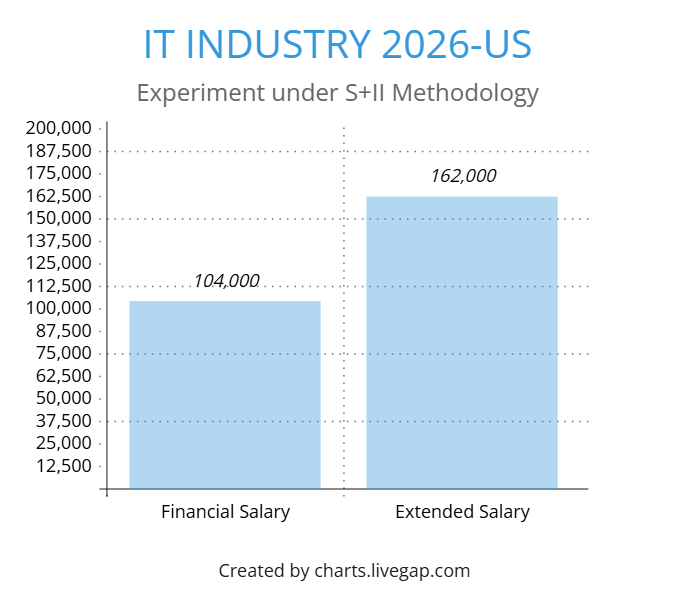
Average salaries in the U.S. programming industry in 2026 range between $133,000 and $149,000 gross annually (average: $141,000), resulting in estimated net salaries between $99,000 and $110,000 (average: $104,000).
The average age in this industry is 39 years old. At this age range, the average American typically has between one and two children. The average financial situation of Americans reflects debt equivalent to approximately 29% of their assets, and this financial assumption is incorporated into our experimental model.
Life expectancy in the United States in 2026 is estimated at 81.4 years for women and 76.5 years for men. Applying an average produces an estimated life expectancy of 78.95 years (79 years).
Although the exact family responsibilities of each employee are unknown, our model assumes a baseline family responsibility factor of 0.5. This value represents the level of family dependency burden. The value used in the model ranges between 0 and 1, where values closer to 1 indicate greater family responsibility and dependent obligations.
Regarding the Ts calculation, we applied a stable, moderate, and non-aggressive average assumption of 1.5. Ts represents the subjective value employees assign to their personal free time. In other words, it measures how valuable free time is compared to working time. For example, if an employee considers one hour of personal time to be twice as valuable as one hour of work time, then Ts = 2.
Perceived health at the age of 39 — the average age in the analyzed industry — is generally considered good. Therefore, we applied a hypothetical health perception level of 90%, assuming that most individuals at this age are in near full physical condition, while recognizing that this may not apply in all cases.
After modeling the previous variables, the resulting average Economic Value of Personal Time (EVPT) is estimated at $193.79 per hour for each employee. In other words, this figure represents the estimated value of every free personal hour for an employee.
According to data from the U.S. Bureau of Labor Statistics (BLS), employees working remotely in professional occupations, including software and IT, work an average of approximately 40 hours per week, of which around 65% are performed remotely.
OTHER COSTS AND SAVINGS GENERATED BY FLEXIBILITY
Costs of Working From Home
There are certain costs incurred by employees when working remotely, such as electricity, heating, air conditioning, and internet expenses. This model assumes that companies do not separately reimburse these costs, or that any reimbursement is already included within the employee’s salary.
On the other hand, employees working from home avoid several direct costs associated with commuting to work, including time spent driving, parking expenses, fuel costs, public transportation expenses, and vehicle depreciation.
In our model, we apply a final adjustment to employee compensation by adding the equation:
Savings generated by flexibility – Additional costs generated by flexibility
Conclusions
After applying the previous assumptions, we estimate that the compensated hourly wage for an employee in the IT and programming sector is approximately $48.17 per hour, while the economic value represented by each hour of personal free time rises to $193.79 per hour.
Given that companies in this industry are highly inclined toward Flexible Work Arrangements (FWAs) and remote work, and considering that approximately 65% of employee working time is flexible, we can estimate the economic impact of recovered personal time.
If employees in this industry were asked how much personal time they recovered during the last year as a result of corporate flexibility, our model assumes an average recovery of approximately 6 hours per week.
Based on an average net salary in the United States of $104,000 in an industry where 65% of work time is flexible, and assuming employees recover 6 hours of personal time per week, the resulting equivalent economic compensation would reach approximately $162,768 annually.
This represents an increase of approximately 56% over the employee’s direct financial salary.